

Interview with Chiron Floris
by Valentina Orrù
12/11/2024
Chiron Floris is an artist and a fashion designer based in Antwerp, Belgium. Her practice delves into the relationship between textiles and individuals, exploring the connections that emerge during creative processes. Interpersonal relationships lie at the heart of Chiron's work, which centers on themes such as ancestral knowledge, migration, and the human search for belonging. Through her exploration of textiles, illustrations, diaries, photography, and film, she weaves together personal stories and cultural narratives, each expressed with poetic sensitivity. Using crafts as her medium, she seeks to uncover the memories embedded within the body, reconnecting with the spirit of specific places and the legacies they hold.

Chiron Floris, research process as part of Sei Pênelópê?’, 2023.
How and where did your relationship with Sardinian culture start?
My relationship with Sardinian culture truly began in 2022 when I started my master’s program. Through my studies, I had the opportunity to conduct both personal and artistic research.
In the 1920s, my great-grandfather came from Cagliari to Antwerp, a couple years later he left Belgium, leaving a son. A few generations later, I inherited his last name and nationality. Despite a deep connection to my birthplace, Maastricht, I always felt a longing for something I couldn’t quite define. Thanks to the master program at KASK, I had the chance to artistically explore this curiosity I had. In January 2023, I traveled to the island for the first time, embarking on a tactile journey across Sardinia. I immersed myself in the traditional crafts of my great-grandfather’s homeland in order to explore my potential history. I stayed on the island for two weeks, visiting Cagliari, Sant’Antioco, Bosa, Ollolai, and Nuoro, where my family tree traces back. These were the first encounters as part of my research, and I found immense joy in connecting with Sardinia in this hands-on way. When words were sometimes lost due to language barriers, communication was bridged through creating with our hands. I look back on this initial encounter with Sardinia with great warmth.
Beyond the planned meetings, I also came across spontaneous encounters. In Cagliari, for example, I was drinking a coffee when, to my surprise, the bartender told me, “il caffè è già pagato”—my coffee had already been paid for by a man who had since left. This gesture touched me, and I drew a parallel between Sardinia and this coffee: both were gifts given by someone who had gone before I could thank him.
You were one of the artists in residence at Ottovolante Sulcis as part of the project Tessere l'arte last year, in Sant’Antioco, an island and town in southwestern Sardinia. How did that experience inform the development and trajectory of your work?
While writing my thesis, I concluded that one becomes part of a place by participating in its local culture of making. The residency Tessere l’arte gave me the chance to deepen my practical research into my family history. Since the program specifically focuses on the local environment and traditional textile practices, it aligned well with my thesis research. I learned embroidery techniques like Punto Smock and Punto Pieno, and how to dye with natural pigments. I view the work produced during the residency as a fragment of my research, then still titled Grandi. In this fragment, I explored the impact of migration on an individual.
In a bed sheet, I mounted parts of the traditional blouse of Sant’Antioco onto fabric; as the body tries to find its way within this blouse—just as one must find their way in a new environment—it must seek balance and adapt to the new surroundings. The work embraces the poetry of repetition and highlights the beauty of rhythmic movement within the territory of Sant’Antioco.
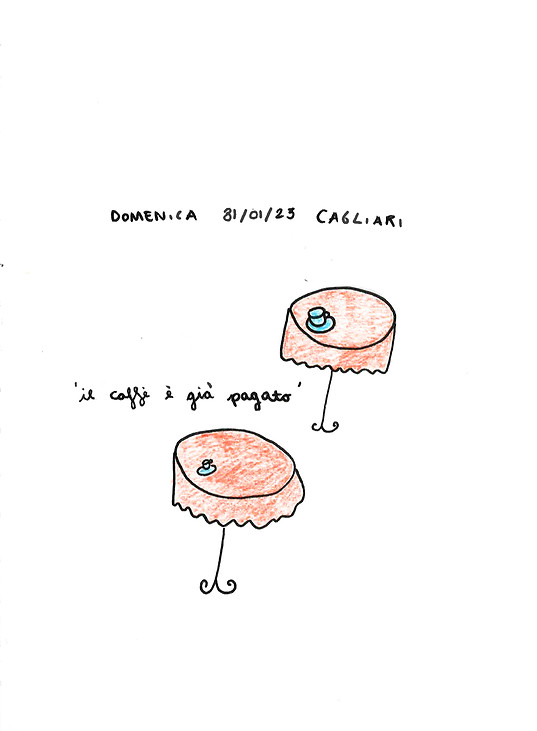
Chiron Floris, research process as part of Sei Pênelópê?’, 2023.
Your practice moves across different disciplines such as crafts, fashion design and visual art. What is your approach and vision around interdisciplinarity? And how does that shape what you do?
For me, interdisciplinarity comes together in the medium of fashion. What I have always found fascinating about fashion is how the way we stand, walk, and hold ourselves is influenced by how we apply fashion to our bodies (the clothes we wear). Practicing a craft, like embroidery, also affects the body in a similar way. The body becomes subject to the rhythm in which it is directed. Additionally, I see fashion as a visual expression of collective memories and a way to connect with others, past generations, or the territory. It acts as a binding factor in human connections, and I believe this can manifest in a wide range of material forms.
I also see it as a relational medium, embodying the tension between traditions and the present, personal stories and collective memories. I have been working with this medium for ten years, and over time my view on it has continued to develop through different experiences and education. In Sardinia, I first encountered the work of Maria Lai, whose practice has had a significant influence on how I view my own work.
Sei Pênelópê is the name of your recent graduation project for the MA in fashion design at KASK and Conservatorium in Ghent, Belgium. Could you talk more about the research and design processes that you followed for it?
I completed my master’s program in two years. In the first year, I conducted preliminary research and wrote my thesis on cultural identity, location/dislocation, belonging, personal narrative, and the Mediterranean region. The research was initially titled Grandi, named after the pseudonym my great-grandfather used when he came to Belgium. I examined the migration history of both Belgium and Sardinia, eventually conducting two weeks of field research in Sardinia. My goal was to explore my potential history and mend a disrupted sense of belonging, exploring 'how it could have been' and testing what the body remembers. This journey began with deep curiosity—I wanted to bridge a gap. I aimed to do this by connecting with local making practices, and since I have a strong affinity for fashion and textiles, that became my focus. During my fieldwork, I spoke with textile and costume experts. Among others, I was introduced to the artistic organization La Foce in Bosa, which is dedicated to preserving Sardinian lace-making, Filet di Bosa. In just a day and a half, I learned about the history of the craft and acquired basic techniques. In addition to textile experts, I also met with collectives like Transhumanza and Pretziada, who work and think about Sardinian cultural identity in a contemporary way.
Although my thesis served as a foundation for my artistic output, starting the second and final year of the master program, I felt I needed to spend more time on the island to create visual work. My second stay in Sardinia lasted two months and was divided into four projects, each lasting two weeks. I began by working on a farm in Sos Alinos, then participated in the residency in Sant’Antioco, followed by a two-week apprenticeship in Filet di Bosa at La Foce in Bosa, and concluded with the residency from Terzomolare and Campanello House in Cagliari.
On the farm, I learned mainly to use my body and to listen to the land. My residency at Ottovolante provided me with technical and conceptual insights. The two weeks spent in Bosa taught me the theory, such as the history and symbolism of the technique, and practice of Filet di Bosa and made me fall (even more) in love with it. In Cagliari, I felt closest to my great-grandfather. Paradoxically, this made me realize that the research was no longer about him but rather about the new encounters and relationships I’d formed on the island. The turning point came when, as I walked through the streets with a Filet di Bosa frame in my hand, a passerby asked me, “Sei Pênelópê?”; He was referring to the wife of Odysseus, who continued handicraft until his return. I decided to rename my research after this question asking myself the question; Am I a Pênelópê who has been waiting for her Odysseus for three generations, handicrafting to come closer to him—and to herself?
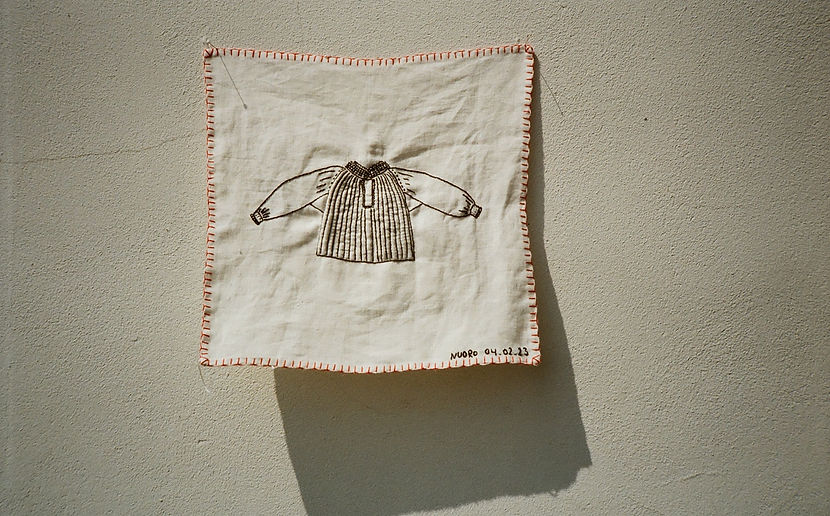
Throughout these two months, I kept a diary, writing or sketching everything I saw, learned, or that fascinated me. Once back in Belgium, it took me some time to figure out how to express my experiences visually. One lingering question was, “How can I give something back?”. Eventually, a local custom inspired me to create talismans for everyone who helped or inspired me during my journey. Each talisman is based on a fragment from my diary and represents shared memories. Each piece is part of a collective whole but also serves an individual purpose. Together, the talismans form a silhouette that embodies the principles of the traditional women’s blouse—a blouse that lasts a lifetime and adapts to life’s events by growing or shrinking with them. The silhouette is accompanied by a sound fragment made in collaboration with Studio Smink, Catherine Willems (KASK, School of Arts Ghent) and Kris D’Août (University Liverpool) — that combines muscle recordings of an embroidering hand with ambient sounds, symbolizing that the making body becomes part of a territory. The rhythm is synchronized with the speed and repetition of the embroidery. A lacework made of flour is part of the installation, it reflects my time with La Foce, particularly highlighting the knowledge I gained about the symbolism in their craft. The work consists of flour because of the symbolic meaning behind grain but also because of its ephemeral nature.
After exhibiting the work, I intend to distribute the fragments to those involved, making room for new memories. My intention was to create a relational work, a blouse that can expand and contract over a lifetime as new memories are made. Next to the textile installation, I have gathered all my memories and experiences into a publication; this is the only part of the work that will remain with me.
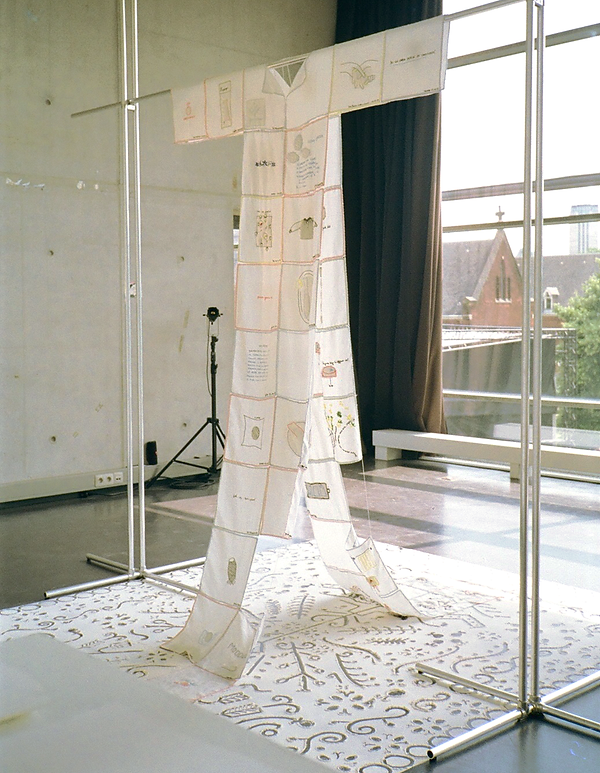
Chiron Floris, ‘Sei Pênelópê?’, installation view at GRADUATION, KASK degree show, 2024.
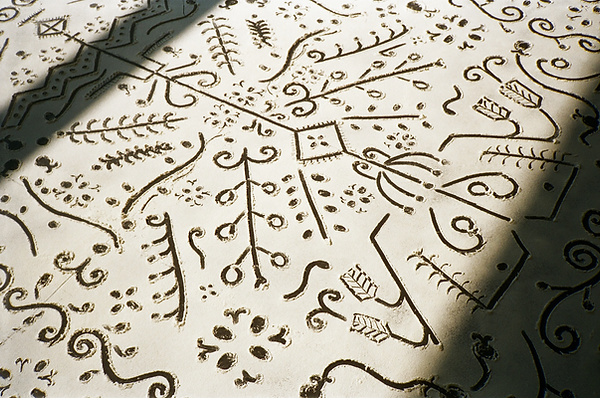
Chiron Floris, ‘Sei Pênelópê?’, close up of installation at GRADUATION, KASK degree show, 2024.
Your previous project Plat Du Jour draws inspiration from kitchen workwear (your dad is a chef!). The pieces combine strong and personal narratives, with carefully developed designs, and reflect on ideas of durability and sustainability. These themes and approach can also be found in Sei Pênelópê. What role has time got in your practice?
I often feel the urge to capture time; I’m quite nostalgic, and this drives me to create monuments of memories. Through my work, I try to grasp things in life for which I can’t find the words. As a result, my work is never about myself but rather about people close to me, those to whom I wish to convey something. The time I dedicate to a piece is like a silent message, it’s about sharing emotions and showing gratefulness. When, during the process of “Sei Pênelópê?”, I decided to create each fragment for a specific person as a gift, a sense of calm came over me. The intention behind the work shifted completely and felt right to me. Each fragment was crafted differently, with the person in mind. I find a kind of poetry in dedicating time to someone.
How do elements such as functionality and aesthetics, tradition and innovation intertwine with each other in your work?
In Sardinia, I learned that when you use your body, you tune into the rhythm of a place. I find it interesting to search for a balance between tradition and the contemporary. I think it’s essential to be mindful of what and how (much) we create nowadays, but I also believe that making is a human need that fosters connections. I think there is a lot of innovation to be found in tradition—innovations we may have forgotten or dismissed as outdated but that are, in fact, very needed.
Regarding aesthetics; I most enjoy it when we get a glimpse into someone’s mind, when someone feels free to experiment and make mistakes. It’s those small imperfections that makes it interesting.
Finally, what have you been up to lately?
I'm always working on multiple things at once; you could call it a kind of patchwork of activities. Currently, I'm working on several exciting projects that I can’t wait to share. Meanwhile, I’m exhibiting ‘Sei Pênelópê?’ in various locations. In October, I had the opportunity to showcase it at the Equilibrio Festival in Porto Ferro, and starting November 16, it will be on display at Arco Iris R in Bologna through Ottovolante, along with other participants from the 2023 residency!
My graduation project doesn’t feel like a completed piece to me but rather the beginning of future research and collaborations both in and outside Sardinia. I’m certain I’ll return to continue my artistic research on the island and to deepen my relationship with it. I’d also love to explore my family archives further. Once ‘Sei Pênelópê?’ has been exhibited, I’ll slowly gift each piece to the people for whom the talismans were made. This prospect brings me a lot of joy, I’m really looking forward to seeing everyone again.